Building materials
Software for building materials stores
Rivoo is software for building materials stores: sales, stock, debts and tradesman bonuses in one place. Sell tiles by the m², profiles by the metre and nails by weight.
Sell by m², metre, weight and pack Tradesman bonuses and payouts Credit sales, due dates and reconciliation acts Wholesale and retail prices
Software for building materials stores: m², metres and packs
Give each product its own unit: tiles in m², profiles in metres, nails in kilograms, cement in bags. For tiles, the cashier enters one piece's width and height and the number of pieces. Rivoo works out the area and the total.
Area from width and height Metres in fractions, like 2.5 m Piece price from the pack price Weighed goods from scale barcodes Bundles of several products
A bonus for the tradesman who brings the client
A tradesman, foreman or designer brings a client and earns a bonus on their purchases. The cashier picks the tradesman on the sale or scans their code. The bonus goes to the tradesman's wallet by the rules you set.
Bonus rules by product and tradesman A bonus wallet for each tradesman Paying with the bonus, in so'm only Cash payout after a waiting period you set Tradesman payouts and a bonus report
Credit sales: see who owes what, and when
On a credit sale you set the due date, as a number of days or a date. The Debt Due Dates report shows each customer's debt and how much is overdue. You check the balance with each customer through a reconciliation act.
A due date on every credit sale Due-dates report and log Reconciliation acts with customers and suppliers Debt balance and act in the Telegram bot
Wholesale and retail prices in one store
Each product can have up to 8 prices, for example wholesale and retail. When the cashier picks a customer, the till switches to that customer's price type. Products priced in foreign currency sell on the same receipt as products in so'm.
Wholesale, retail and other price types So'm and foreign currency on one receipt Exchange rates with history
Orders, delivery and several warehouses
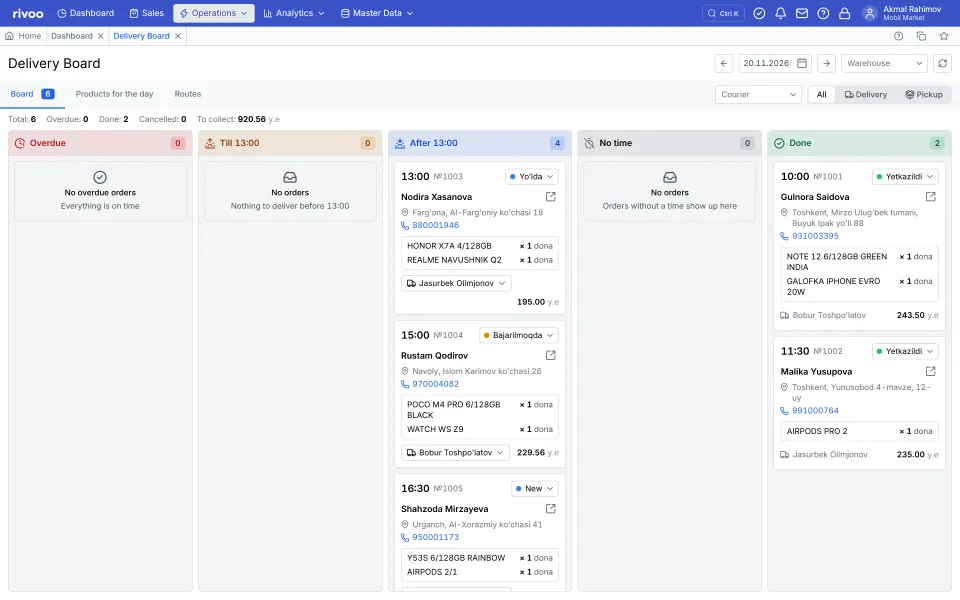
Large purchases are often delivered later. The day's orders sit on the delivery board by delivery time, and you assign the courier there. If the warehouse and the store are separate, you see the stock in each and the transfers between them.
Delivery board and couriers Order payments Stock by warehouse Transfers between warehouses
Pricing
Which plan do I need?
Credit sales, foreign-currency accounting and several price types start with the Plus plan: 339 000 so'm a month, with 5 users and 2 warehouses. If you don't need them, Start costs 179 000 so'm a month. Work out your exact price with the calculator in the Pricing section.
Frequently asked questions
Can I sell tiles by the m²?
Yes. On the product card, choose the Area type. The cashier enters width, height and the number of pieces, and Rivoo works out the m² and the total.
Can I give tradesmen a bonus?
Yes. You set the bonus rules, and the cashier picks the tradesman on the sale or scans their code. Tradesmen spend the bonus on their own purchases or take it in cash.
Can I track credit sales and due dates?
Yes. Each credit sale has a due date, and the Debt Due Dates report shows what is overdue. Credit sales start with the Plus plan.
Can I set separate wholesale and retail prices?
Yes. A product can have up to 8 prices, and the till switches to the customer's price when you pick them. Several price types start with the Plus plan.
Can I sell by the pack and by the piece?
Yes. On the product card you enter the units per pack and the pack price, and Rivoo works out the piece price. At the till, whole packs and loose pieces go on one line.
Can I manage deliveries too?
Yes. The day's orders sit on the delivery board: you assign a courier and see how much money to collect. When an order is completed, its goods leave stock automatically.
More solutions
Try it today
Open the demo or message us on Telegram and we'll walk you through it.